Bowel-wall ultrasound at week 4–8: a 2026 systematic review on whether intestinal ultrasound can flag treatment response in IBD early — and the parts the same review keeps small
A 2026 systematic review and pooled data analysis in the Journal of Crohn's & Colitis brings together 31 studies (18 Crohn's disease, 9 ulcerative colitis, 4 acute severe ulcerative colitis) on intestinal ultrasound as a non-invasive way to predict treatment response. In anti-TNF-treated Crohn's patients, a roughly 23% drop in bowel wall thickness at week 4–8 carried an AUROC of 0.82 for predicting later response — useful, but heterogeneous studies and small UC/ASUC subsets mean this is a research-direction read-out, not a personal decision rule.
Listen to this article · AI-generated narration
For people living with inflammatory bowel disease, one of the steady, quiet questions in the background of treatment is is this working? The condition — Crohn's disease or ulcerative colitis — is the kind of long-term illness where the bowel becomes inflamed in flares that settle and return, and current NHS guidance describes IBD in exactly those terms: a long-term condition where the gut becomes inflamed, which usually needs to be monitored over time to guide treatment decisions [1]. The tools that monitoring tends to lean on, as described on the NHS Crohn's-disease and ulcerative-colitis pages, are endoscopy (a camera looking at the bowel lining directly through colonoscopy or flexible sigmoidoscopy), magnetic resonance imaging of the small bowel, and stool or blood markers such as faecal calprotectin and C-reactive protein [2]. They work — but each carries its own load. A colonoscopy is invasive and burdensome, MRI is expensive and not always close to hand, and stool/blood markers, while useful, are indirect.
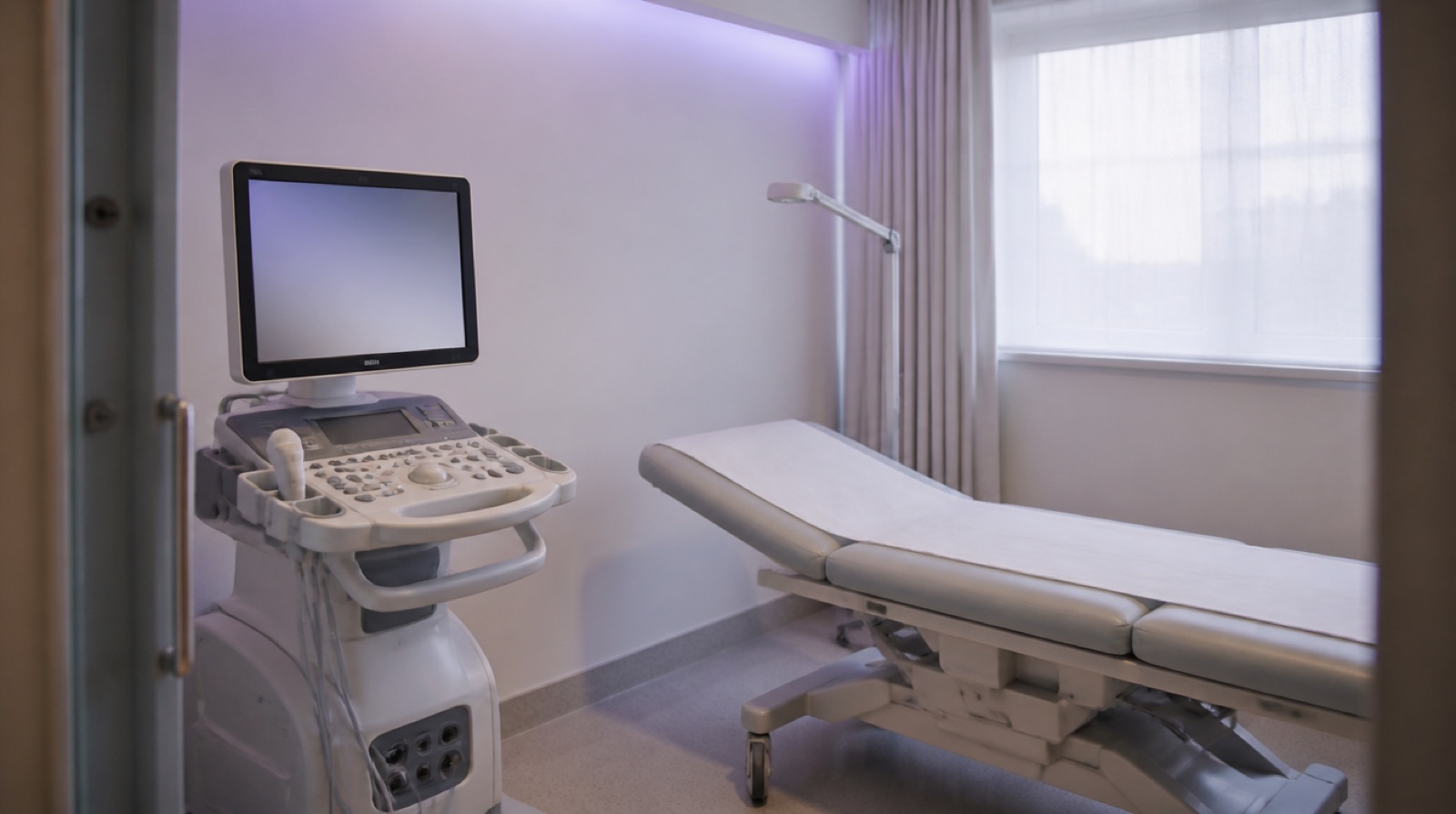
Intestinal ultrasound is a different shape of tool. Done with the patient on a couch and a probe on the abdomen — no sedation, no bowel prep, no contrast — it lets a trained operator look at how thick the bowel wall has become, which is one of the most direct signs of ongoing inflammation. The question this 2026 systematic review takes on is not whether ultrasound can see inflammation; that is already well established. The question is whether, after a treatment has been started, a few weeks of ultrasound follow-up can pick up — early — whether that treatment is going to work.
In 2026, the Journal of Crohn's & Colitis published a systematic review and pooled data analysis on exactly that question, with a literature search up to May 2025. The review brought together 31 studies — 18 in Crohn's disease, 9 in ulcerative colitis, and 4 in acute severe ulcerative colitis (the in-hospital, steroid-resistant form that often raises the question of urgent salvage therapy) [3].
In Crohn's disease, the pattern across the studies was reasonably consistent. In 8 of the 10 Crohn's-disease studies that examined the 4–8-week window after starting treatment, intestinal ultrasound at that point distinguished future responders from non-responders. The change in bowel wall thickness ranged from −43% down to −14.6% in responders, versus a much shallower band of −14% to +2% in those who went on not to respond [4]. The pooled analysis is the part the review can lean on hardest: in 236 Crohn's-disease patients started on anti-TNF therapy (the older class of biologic that includes infliximab and adalimumab), a 23% decrease in bowel wall thickness from baseline at week 4–8 carried an area under the receiver operating characteristic curve of 0.82 for predicting future treatment response, and a 27% decrease at week 12–16 carried an AUROC of 0.78 [5]. An AUROC of 0.82 means the test does discriminate — but the same number, said carefully, also means it does not discriminate perfectly. It is a signal, not a verdict.
In ulcerative colitis the picture is thinner, on purpose: only 2 of the included UC studies looked at the same week 4–8 question, and in both, the ultrasound after 4–8 weeks was associated with future endoscopic remission versus non-remission — with bowel wall thickness changes of −55% to −49% in those who later achieved remission, versus −38% to −17% in those who did not [6]. The acute severe ulcerative colitis subset is where the question becomes most clinically time-pressured: in the 4 ASUC studies the review identified, a change in bowel wall thickness as early as 1–3 days into treatment was associated with whether a patient went on to need salvage therapy — −34% in those who avoided salvage versus −10% in those who needed it [6]. Four studies is a small base for any conclusion, and the review is explicit about pooling fewer of these together for that reason.
The honest read on this evidence is that intestinal ultrasound is on its way to being a useful early read-out of whether a treatment is working, not a finished one. A systematic review can pull a signal out of a literature that no individual study could carry alone, but it cannot make the studies underneath it bigger or more uniform; in this review the ulcerative-colitis and acute-severe-ulcerative-colitis subsets rest on 2 and 4 studies respectively, so the headline pooled AUROC numbers in anti-TNF Crohn's disease sit on more evidence than the UC and ASUC numbers do [7]. The size of the response — a roughly quarter drop in bowel wall thickness at week 4–8 — is also a research description of a group, not a personal threshold for any one person. What counts as "working" for any given patient depends on what treatment they are on, how their disease was distributed and how active it was at baseline, who is holding the ultrasound probe, and a dozen other clinical specifics no systematic review can speak to.
For someone living with IBD — and especially someone in the middle of starting a new biologic and wondering when they will know — three things from this review may be worth carrying with you, kept small on purpose. First, intestinal ultrasound is a real, low-burden way of looking at how inflamed the bowel wall is, and it is increasingly being used to monitor treatment response without sending the patient back through repeated colonoscopies. Second, the 2026 evidence base on its predictive value is most settled for anti-TNF-treated Crohn's disease — useful but not perfect, and earliest at around week 4–8 — and thinner, though directionally similar, for ulcerative colitis and ASUC. Third, whether it is the right tool for your follow-up, and what any given change in bowel wall thickness means for your treatment plan, is a conversation that belongs with the gastroenterology team who knows your history, not with a curated explainer. We're a curation hub, not a clinic.
Sources
- NHS — Inflammatory bowel disease (T1, authority guidance): https://www.nhs.uk/conditions/inflammatory-bowel-disease/
- NHS — Crohn's disease: Diagnosis (T1, authority guidance, also referenced for ulcerative colitis monitoring patterns): https://www.nhs.uk/conditions/crohns-disease/diagnosis/
- Systematic review of the predictive value of intestinal ultrasound for treatment response in IBD, Journal of Crohn's & Colitis, 2026 (T2, systematic review and pooled data analysis; 31 studies; literature search to May 2025): https://pubmed.ncbi.nlm.nih.gov/41983602/
- Same systematic review as [3] — Crohn's disease finding: in 8/10 studies intestinal ultrasound at week 4–8 distinguished future responders, bowel wall thickness change −43% to −14.6% in responders vs −14% to +2% in non-responders.
- Same systematic review as [3] — pooled anti-TNF Crohn's disease analysis (n=236): 23% bowel wall thickness decrease at week 4–8 (AUROC 0.82) and 27% decrease at week 12–16 (AUROC 0.78) predicted future response.
- Same systematic review as [3] — ulcerative colitis subset (2 studies, −55% to −49% vs −38% to −17% at week 4–8 for endoscopic remission vs non-remission) and acute severe ulcerative colitis subset (4 studies, bowel wall thickness change at 1–3 days, −34% vs −10% for avoidance vs need for salvage therapy).
- Same systematic review as [3] — the structure of the evidence base itself: 18 Crohn's disease, 9 UC, 4 ASUC included studies, with the pooled anti-TNF Crohn's analysis being the most evidence-dense subset.
How we source and license content
Content ID: OF-521505Quote this ID in a copyright or correction request.