
After Crohn's Surgery: The Growing Case for Intestinal Ultrasound as a Monitoring Tool
A 2026 international consensus study published in The Lancet Gastroenterology & Hepatology used the RAND/UCLA appropriateness method to evaluate exactly when intestinal ultrasound is appropriate for detecting postoperative Crohn's disease recurrence, drawing on 21 international experts to produce the first structured guidance on this non-invasive monitoring approach.
Listen to this article · AI-generated narration
For people with Crohn's disease who have had bowel surgery, the question of what monitoring comes next shapes clinical care for years. Surgery can bring lasting relief from severe disease, but it does not eliminate Crohn's disease from the body. The condition has a well-documented tendency to return at or near the surgical site, and identifying that recurrence early opens a window for treatment decisions that may prevent further complications.
A 2026 international consensus study published in The Lancet Gastroenterology & Hepatology has now produced the first structured guidance on exactly when intestinal ultrasound is appropriate for detecting this recurrence, drawing on 21 gastroenterologists, radiologists, and IBD specialists from multiple countries (Lancet Gastroenterol Hepatol, 2026).
Why Postoperative Monitoring Matters
The NHS states that Crohn's disease is a lifelong condition where remission can be followed by flares, and that regular monitoring and follow-up with a gastroenterology team is part of ongoing management for most people with the condition (NHS: Crohn's disease). After surgery, this monitoring takes on additional importance because Crohn's can return at the point where the bowel was rejoined, a site called the anastomosis.
Postoperative recurrence is not uncommon. Clinical research has consistently shown that endoscopic signs of recurrence appear in a substantial proportion of patients within the first one to two years after ileocolonic resection, even in people who feel well. This matters because endoscopic recurrence often precedes clinical symptoms by months. Waiting for symptoms to return before investigating means missing a window where treatment intensification is most effective.
Early detection of recurrence allows the clinical team to consider whether the current maintenance therapy is working, or whether a change in approach is warranted before significant bowel damage occurs.
The Limitation of the Gold Standard
Traditionally, the reference standard for detecting postoperative Crohn's recurrence has been ileocolonoscopy, in which a flexible camera is guided through the bowel to directly visualise the intestinal lining and grade any recurrence at the anastomosis.
Colonoscopy is accurate, but it is invasive. It requires bowel preparation, sedation in many cases, and carries procedural discomfort and a small but real risk of complications. For a follow-up monitoring pathway that may need to be repeated at regular intervals for years, the burden of repeated colonoscopies can affect how consistently patients attend. Some people delay or avoid scheduled surveillance because of that burden.
What Intestinal Ultrasound Is
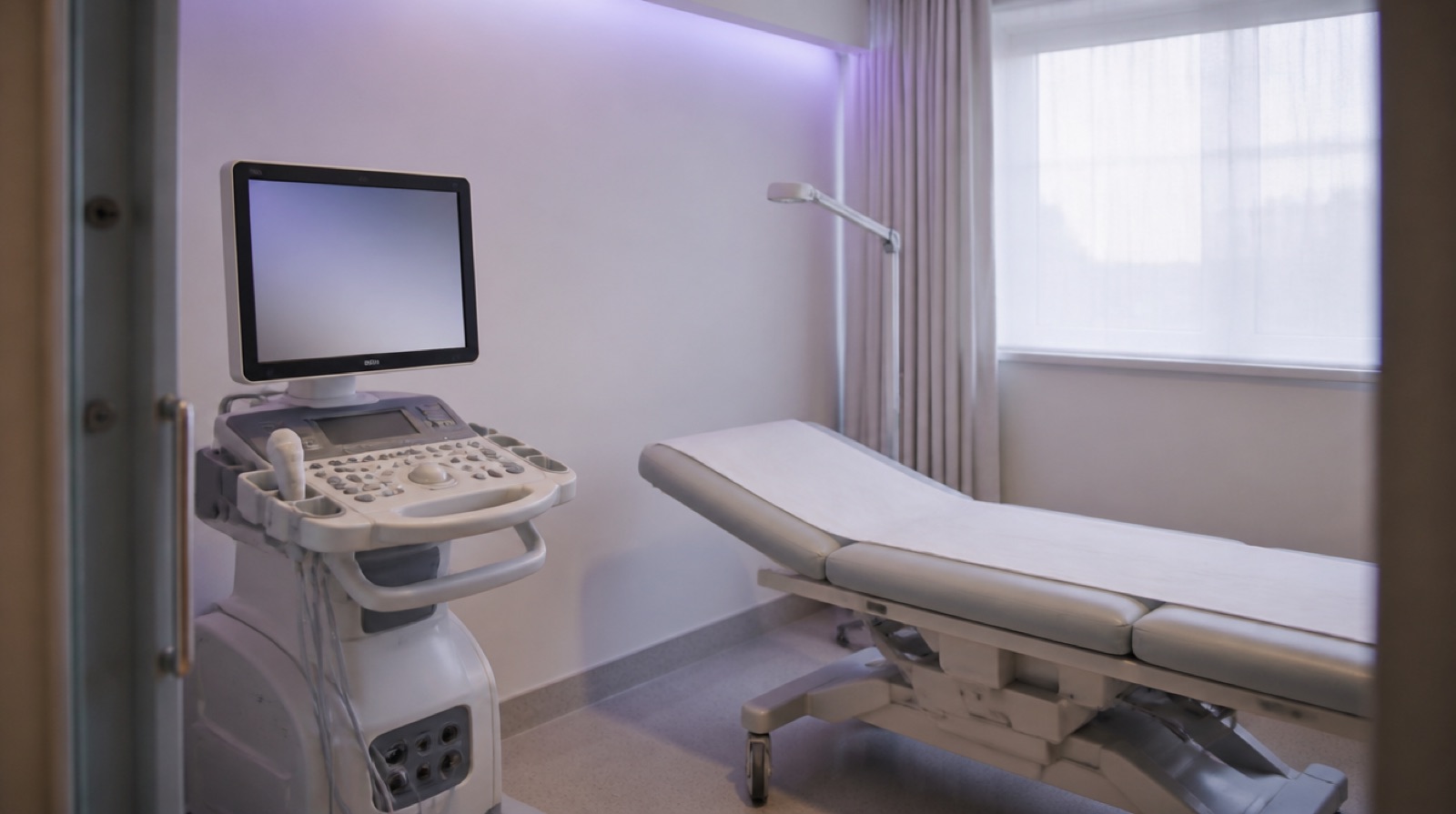
Intestinal ultrasound (IUS) uses a standard ultrasound probe placed on the abdomen to image the bowel wall. Unlike colonoscopy, it is non-invasive, requires no bowel preparation, involves no radiation, and can be performed in an outpatient or clinic setting without sedation. The examination typically takes 15 to 30 minutes.
In Crohn's disease, the bowel wall becomes thickened during active disease and returns toward normal thickness in remission. IUS measures this wall thickness directly and can also assess blood flow and structural changes. Multiple studies have examined how well IUS correlates with endoscopic findings, and its accuracy has been validated as a tool for monitoring disease activity in IBD.
At the anastomosis after surgery, IUS can detect bowel wall thickening and other structural changes associated with recurrence. Research has shown that IUS findings at this site correlate with endoscopic scoring of postoperative recurrence. This makes it a meaningful, non-invasive alternative to colonoscopy in appropriately selected clinical situations.
The RAND/UCLA Appropriateness Method
The challenge is knowing precisely which situations those are. Individual studies establish accuracy metrics, but they do not always translate clearly into clinical guidance about when IUS is the right tool for a specific patient at a specific time point after surgery.
The 2026 Lancet study addressed this gap using the RAND/UCLA appropriateness method. This is a validated consensus technique widely used in medicine to develop clinical guidance when evidence exists but is not yet fully translated into specific recommendations. The method works by combining a structured literature review with a multi-round panel process.
Experts rate the appropriateness of specific, pre-defined clinical scenarios on a scale, see one another's ratings anonymously between rounds, discuss areas of disagreement, and revise their ratings before a final round. Scenarios where ratings converge on the upper end of the scale are classified as appropriate; those converging at the lower end are classified as inappropriate; and those where substantial disagreement remains are classified as uncertain.
The panel for this study comprised 21 specialists across gastroenterology, radiology, and IBD care, drawn from multiple countries. This international and multidisciplinary composition means the resulting guidance reflects a consensus that is not limited to any single national practice context or professional society.
What This Study Represents
Before this study, clinicians interested in using IUS for postoperative Crohn's monitoring had to draw on a mix of individual studies, local protocols, and their own clinical experience. There was no structured international consensus on which patient scenarios made IUS use appropriate, which made it harder to apply the evidence systematically or to explain to patients why IUS might or might not be suitable in their particular case.
A RAND/UCLA appropriateness analysis does not establish IUS as a replacement for colonoscopy. It establishes something more nuanced and more clinically useful: a structured map of which scenarios are agreed by international experts to be appropriate for IUS monitoring, and by implication, which are not. That distinction matters for clinical decision-making and for conversations between patients and their care teams.
What People With Crohn's Should Know
For anyone who has had surgery for Crohn's disease, the main practical takeaway from this study is that monitoring options are evolving. IUS is not universally available at the same level of quality across all centres; its accuracy depends significantly on operator training and the local expertise of the team performing the examination. Where IUS is available with appropriate expertise, it may offer a less burdensome monitoring pathway for suitable patients.
Whether IUS is an option for a particular individual depends on multiple clinical factors: the type of surgery performed, the current maintenance treatment, how the disease has been behaving since surgery, and whether the treating centre has IUS expertise. These are questions for a gastroenterologist or IBD specialist, not something that can be determined from a study summary.
What this consensus study contributes is a shared clinical framework, grounded in international expert agreement, for having that conversation.
Sources
How we source and license content
Content ID: OF-200632Quote this ID in a copyright or correction request.